We All Need the Good Shepherd

“Jesus said: ‘I am the good shepherd. A good shepherd lays down his life for the sheep. A hired man, who is not a shepherd and whose sheep are not his own, sees a wolf coming and leaves the sheep and runs away, and the wolf catches and scatters them. This is because he works for pay and has no concern for the sheep. I am the good shepherd, and I know mine and mine know me, just as the Father knows me and I know the father; and I will lay down my life for the sheep. I have other sheep that do not belong to this fold. These also I must lead, and they will hear my voice, and there will be one flock, one shepherd. This is why the Father loves me, because I lay down my life in order to take it up again. No one takes it from me, but I lay it down on my own. I have power to lay it down, and power to take it up again. This command I have received from my Father’” (Jn 10:11-18). 

We live at a time when many of us believe we have no need of a shepherd, let alone anyone who asks anything of us. And an authority or leader who asks us to follow, learn, and sacrifice? Not a chance. Clearly, however, we are misguided in thinking it is our autonomy and “freedom” from such an authority that strengthen us and give our lives meaning. 

Indeed we are like sheep in need of not only a shepherd, but also a truly good one. What would happen to the flock without Him? The sheep would disperse; get lost; be eaten by predators. And what if the shepherd is not a good man? If shepherding is only a job, he doesn’t have a love for his sheep. He doesn’t really care about them. This “shepherd,” when he “sees a wolf coming…leaves the sheep and runs away.” He simply punches in and out to put in his time. And he will quit when the work becomes too challenging. This shepherd “is not a shepherd” at all “because he works for pay and has no concern for his sheep.” 

Sounds familiar, right? Looks like our culture, doesn’t it?

Yes, God gives us the freedom to reject Him. We can deny Him and that we need a shepherd at all. But then what happens? We each go our own way. We don’t want to get lost or eaten, but we do, because we have no wisdom, no virtuous guidance. Sin seduces us into thinking we can do everything ourselves—on our own. “Who needs a God to guide us?” we ask. “I have a good heart,” we tell ourselves. “I know right from wrong.” 

We have become so disconnected from the Lord that we can no longer recollect our oneness with Him. That we don’t need God is a lie we have purchased in the expectation of obtaining power and freedom from Truth. And we have done so to the detriment of our very souls, which are then separated from this Truth. 

Jesus tells us that true freedom is not found in separation, but rather in “belonging,” in living in  “oneness” with Him. And it’s not only that we are part of “one flock,” which Jesus leads. We also “hear [His] voice” and listen to Him. We are obedient to Him. Just as Jesus is in eternal relationship with the Father—“the Father knows me and I know the Father”—so does He call us into relationship: “I know mine and mine know me.” In addition, it is Jesus’s oneness with the Father that calls Him to do God’s will. In sacrificing His life, He exemplifies not only ultimate freedom, but also ultimate love: “I lay down my life in order to take it up again. No one takes it from me, but I lay it down on my own. I have the power to lay it down, and power to take it up again.” Jesus is not a victim. He chooses His path, losing none of His “power.” Rightly ordered to His Father’s “command,” He remains in complete alignment with His will. 

We are all sheep. And we need the Good Shepherd to walk with and guide us. May we discover ways to get quiet enough everyday so that, like the flock, we can hear His voice. He’s right with us in our midst. Let us follow Him.
Some Thoughts on Discernment

For a long while, I used the word “discernment” incorrectly. Does this resonate with you? I used to think it refers to the ability to make thoughtful decisions—to judge well or gain a better understanding of a situation. Now, however, I see that it points to something much deeper. Discernment in fact infuses every aspect of our relationship with God. 

Discernment is not only our ability to hear God’s voice, but also to listen to Him. The Lord invites us to be obedient to His call so that we may answer Him and ultimately enter into an ever deeper love with Him. As early Church Father Origen tells us, “God doesn’t not want to impose the good, but wants free beings….No one but God knows what our soul has received from him, not even ourselves” (CCC 2847). Indeed, in order to discern God’s will for us, we must be able, have the liberty to, love Him. “We can only love in freedom, which is why the Lord created us free, free even to say no to Him” (Pope Francis, December 7, 2022). One may think, “I would never say no to God.” But is that so? Do we always accept our struggles as invitations to grow in friendship with God? And “between [our] trials,” so that we may grow and mature in our faith, do we surrender to the Holy Spirit who calls us to “discern” how to reorder ourselves to Him (CCC 2847)? Only if we are able to actually deny God can we whole-heartedly assent to His love for us, which is ever-present and always precedes our denial.  

Discernment is greater than our ability to merely understand God. It is the awareness that in our relationship with Him, the Lord asks everything of us. How we listen and respond will ultimately determine the degree to which we discern well and love Him completely.

https://www.vaticannews.va/en/pope/news/2022-12/pope-francis-general-audience-discernment-confirmation.html

Do You Know Who You Are in the Fear of the Lord?

Today we celebrate Pentecost when God gifted, confirmed, us with the Holy Spirit. Jesus, appearing to the apostles in a locked upper room where they were hiding in fear for their lives, entered, offered a blessing, and breathed on them.

This life-giving breath is the Holy Spirit, imbued with charity, which is the perpetual relational outpouring of love shared between the Father and the Son.

There are seven gifts of the Holy Spirit: Wisdom, Understanding, Counsel, Fortitude, Knowledge, Piety, and Fear of the Lord, but perhaps the most challenging to understand is the last. If scripture entreats us to not be afraid, if Saint Pope John Paul II repeatedly lovingly invites us to do the same, why does this gift seem contradictory?

As Father Gregory and Father Patrick discuss in this podcast, St. Thomas Aquinas listed three types of fear: worldly, servile, and filial. While calling us to address different forms of fear in our lives, all three point to this Gift of the Holy Spirit, which ultimately invites us into relationship with God. We are not meant to simply fear Him for our sinfulness, but rather this is a fear which more specifically coexists with our right reverence for Him.

In other words, our fear of losing things, social standing, punishment, and ultimately disappointing God should order us understand that God is greater than all these fears. This Gift reminds us that He has the power to heal all suffering in ways we cannot understand. Fear of the Lord invites us to rest in Him always; to love him as Father and redeemer in whom “we live and move and have our being” Acts 17:28).

Do You Know Who You Are? God Reveals Himself to Us in the Darkness

Father Blount reminds us that it is in the darkness, in our suffering, even when we feel abandoned and lost to ourselves, we are not orphans. We are His. We belong to God. Jesus tells us, “I will not leave you as orphans; I will come to you” (John 14:18). In our despair and loneliness, we might not see God. We might feel separated from Him. But Jesus reminds us, “Before long…you will see me. Because I live, you also will live” (John 14:19).

When it is dark, when we can’t see, let us cry out to God who is always calling us to communion with Him. He is with us. In Him we shall be made whole and be healed.

Wherefore Power?

How often do we refer to the parent-child relationship as a power struggle? Who has the power? The bigger, louder, sometimes out-of-control grown-up, or the smaller weaker, sometimes out-of-control kid? When a toddler throws a tantrum, who has the power? The screaming parent or the shrieking child who’s pulling the posters off his wall?

When a parent is angry and yelling, and the child is quiet and intimidated, who holds it then? There seems to be little doubt who holds more power. But is this so? Superficially, yes. But it is pretty evident that this is not only misused power, but it is also at the very least ineffective and at the worst destructive in the long term.

What about when a child is angry and screaming and the parent is evasive, unavailable, and non-responsive? Who holds the power then? Now the child is in charge, as it were. But this can be destructive too, can’t it? A cowering parent and an aggressive child is also a destructive dynamic in which neither party feels heard and seen and understood. This doesn’t lead to evolution either.

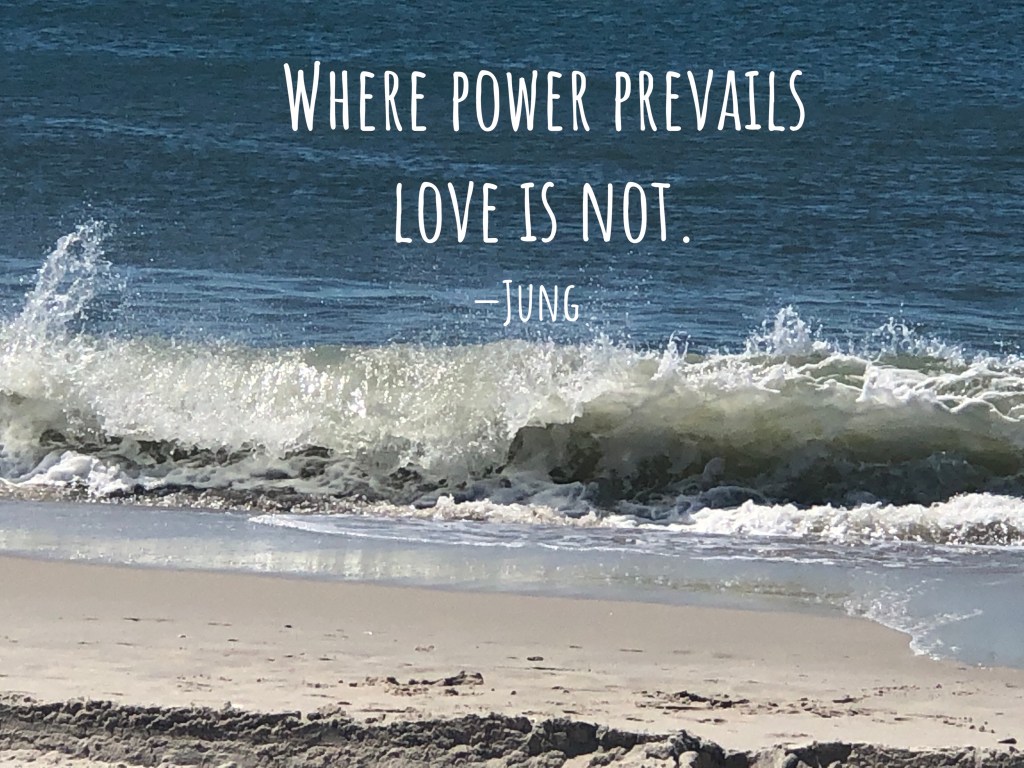
So what of these power struggles? Power itself is not inherently bad. It is how we interpret and use power that matter most. In other words, power over another always leads to the devaluing of the other, as well as the toxic inflation of the one in control.

Empowerment of self, however, well that’s another thing altogether. To be self-empowered, to be fully present to one’s own voice and truth, is to align with nothing less than one’s highest truth. And this truth, in its essence, is love. It is eternal. It is the continuous infilling and outpouring of itself.

In every relationship, then, even in the dance that is the parent-child dynamic, if one uses power to exert her will on another, this is not love. If one tries to control or manipulate the other, this power is not love. It is only through empowerment, indeed fulfillment, of self that we can be in the presence of our parent or child (the “other”) and find alignment, regardless of the conditions the other presents.

Love can only exist when the scorching destructive flames of power give way to the cooling life-giving waters of freedom and evolution.