Jesus Heals Through His Humanity

During the month of July, Catholics celebrate the Precious Blood of Jesus. We are invited to contemplate our Lord’s sacrifice—literally the pouring out of His life force for all of humanity itself. It seems timely, then, that on the eve of this devotional time in the Church, we read from Mark about Jesus’s encounter with Jarius and the woman suffering from a hemorrhage. Why timely? Because this story, which in its graceful arc intricately and artfully entwines two distinct and co-equal plots, highlights our Lord’s humanity. Yes, it is His divinity that miraculously heals. But it is Jesus’s willingness and desire to physically and emotionally encounter the other in his and her humanness that ultimately invite and allow for physical and spiritual restoration.

In Mark 5:21-43, the narrative is shaped and informed by physicality. The crowds are loud and chaotic as they press on and push against Jesus, and even the private moments are characterized by tender physical intimacy. Integral to Jesus’s humanity is His attentive listening. This “human skill,” this “fruit” that defines Christ’s “path,” becomes and forms the path of the story itself (Spiritual Direction Certificate Program, 2019, p. 1).

Jairus appears, begging Jesus to heal his dying daughter. Jesus immediately answers this call into relationship with him, “leaving [Himself] behind…[and] entering fully into [Jairus’s] narrative” (Spiritual Direction, et. al., 2019, p. 1). The woman is introduced amidst this chaos, and the story shifts. Faithful despite her suffering, she is drawn to Jesus’s humanity. He is moving away from her, mobbed by followers, but she pursues Him, believing, “If I but touch his clothes, I will be made well” (5:28). As soon as she touches Jesus, He not only enters her reality, into relationship with her, He “becomes” her reality. “Immediately her hemorrhage stopped,” and Jesus was “[i]mmediately aware that power had gone forth from Him” (5:29-30). What’s more, to the incredulity of His disciples, He asks who touched Him. Jesus questions not only to “listen to others,” but also to form relationships with them—“to hear and explore what is on the other’s heart and mind” (Spiritual Direction, et. al., 2019, p. 1). The woman, knowing “in her body that she was healed” (5:29), could have quickly exited, but Jesus calls her to Him, her former unclean “qualities fad[ing] into…insignificance” (Van Kaam, 1996, p. 19). 

It is also significant that the woman’s hemorrhaging blood simultaneously represents the essence of her societal “uncleanliness” as well as the life force that had been draining from her for years and causing her terrible suffering. Both her status as an outcast and a woman in constant pain results in her separateness from others—physically, emotionally, and spiritually. It is in Jesus’s vibrant humanity, however, that He stops the purging of this life force, returning not only her body but also, because of her faith, her spirit to right order.

While Jesus is still speaking to the woman, we are suddenly thrust back into the clamoring crowd. People are telling Jairus the girl is already dead. Hearing or ignoring this, Jesus comforts him “with reassurances of His love” (Acklin & Hicks, 2017, p. 52). Taking only Jairus, Peter, James, and John with Him, Jesus is again immersed in suffering: “weeping and wailing” at the girl’s house. He invites the family to believe the child only sleeps, but they reject this offer of faith, laughing at Him instead. Jesus’s rises up in the strength and tenderness of His humanity, sending them away, and moving towards the girl, into the sanctum of her room (of her being). His actions say, “[L]et me concentrate on giving you my entire attention” (Sullivan, 2000, p. 126), and He calls her into relationship with Him, commanding, “Talitha Cum” (5:41). This healing, unlike that of the woman, is intensely private; Jesus instructs the parents to tell no one. His humanity is delightfully lastly revealed when He pragmatically tells the girl’s parents to “give her something to eat” (5:43). Like her soul, her body requires nourishment, as well.

These stories prompt us to ask, When we suffer, will we have Jairus’s courage to beg for Jesus’s help? When we experience severe emotional and physical pain, will we persevere as the outcast woman, crawling through the crowd to touch Jesus’s garment? Let us pray that indeed we will. As our faith deepens, may we understand that the “human encounter” with Jesus is “the essence of cure in the deepest sense,” and that He calls us to Him through the fortitude of faith (Van Kaam, 1996, pp. 19-20).

Acklin, T., & Hicks, B. (2017). Vulnerability. In Spiritual Direction: A Guide for Sharing the Father’s Love (pp. 49-74). Emmaus Road Publishing.

Spiritual Direction Certificate Program (2019). What Does It Mean To Listen? (p. 1). Unpublished. 

Sullivan, J.E. (2000). The Healing Power. In The Good Listener (pp. 124-128). Ave Maria Press.

Van Kaam, A. (1996). Counseling and Psychotherapy as Human Encounter. In The Art of Existential Healing (pp. 15-40). Dimension Books.
We All Need the Good Shepherd

“Jesus said: ‘I am the good shepherd. A good shepherd lays down his life for the sheep. A hired man, who is not a shepherd and whose sheep are not his own, sees a wolf coming and leaves the sheep and runs away, and the wolf catches and scatters them. This is because he works for pay and has no concern for the sheep. I am the good shepherd, and I know mine and mine know me, just as the Father knows me and I know the father; and I will lay down my life for the sheep. I have other sheep that do not belong to this fold. These also I must lead, and they will hear my voice, and there will be one flock, one shepherd. This is why the Father loves me, because I lay down my life in order to take it up again. No one takes it from me, but I lay it down on my own. I have power to lay it down, and power to take it up again. This command I have received from my Father’” (Jn 10:11-18). 

We live at a time when many of us believe we have no need of a shepherd, let alone anyone who asks anything of us. And an authority or leader who asks us to follow, learn, and sacrifice? Not a chance. Clearly, however, we are misguided in thinking it is our autonomy and “freedom” from such an authority that strengthen us and give our lives meaning. 

Indeed we are like sheep in need of not only a shepherd, but also a truly good one. What would happen to the flock without Him? The sheep would disperse; get lost; be eaten by predators. And what if the shepherd is not a good man? If shepherding is only a job, he doesn’t have a love for his sheep. He doesn’t really care about them. This “shepherd,” when he “sees a wolf coming…leaves the sheep and runs away.” He simply punches in and out to put in his time. And he will quit when the work becomes too challenging. This shepherd “is not a shepherd” at all “because he works for pay and has no concern for his sheep.” 

Sounds familiar, right? Looks like our culture, doesn’t it?

Yes, God gives us the freedom to reject Him. We can deny Him and that we need a shepherd at all. But then what happens? We each go our own way. We don’t want to get lost or eaten, but we do, because we have no wisdom, no virtuous guidance. Sin seduces us into thinking we can do everything ourselves—on our own. “Who needs a God to guide us?” we ask. “I have a good heart,” we tell ourselves. “I know right from wrong.” 

We have become so disconnected from the Lord that we can no longer recollect our oneness with Him. That we don’t need God is a lie we have purchased in the expectation of obtaining power and freedom from Truth. And we have done so to the detriment of our very souls, which are then separated from this Truth. 

Jesus tells us that true freedom is not found in separation, but rather in “belonging,” in living in  “oneness” with Him. And it’s not only that we are part of “one flock,” which Jesus leads. We also “hear [His] voice” and listen to Him. We are obedient to Him. Just as Jesus is in eternal relationship with the Father—“the Father knows me and I know the Father”—so does He call us into relationship: “I know mine and mine know me.” In addition, it is Jesus’s oneness with the Father that calls Him to do God’s will. In sacrificing His life, He exemplifies not only ultimate freedom, but also ultimate love: “I lay down my life in order to take it up again. No one takes it from me, but I lay it down on my own. I have the power to lay it down, and power to take it up again.” Jesus is not a victim. He chooses His path, losing none of His “power.” Rightly ordered to His Father’s “command,” He remains in complete alignment with His will. 

We are all sheep. And we need the Good Shepherd to walk with and guide us. May we discover ways to get quiet enough everyday so that, like the flock, we can hear His voice. He’s right with us in our midst. Let us follow Him.

Some Thoughts on Discernment

For a long while, I used the word “discernment” incorrectly. Does this resonate with you? I used to think it refers to the ability to make thoughtful decisions—to judge well or gain a better understanding of a situation. Now, however, I see that it points to something much deeper. Discernment in fact infuses every aspect of our relationship with God. 

Discernment is not only our ability to hear God’s voice, but also to listen to Him. The Lord invites us to be obedient to His call so that we may answer Him and ultimately enter into an ever deeper love with Him. As early Church Father Origen tells us, “God doesn’t not want to impose the good, but wants free beings….No one but God knows what our soul has received from him, not even ourselves” (CCC 2847). Indeed, in order to discern God’s will for us, we must be able, have the liberty to, love Him. “We can only love in freedom, which is why the Lord created us free, free even to say no to Him” (Pope Francis, December 7, 2022). One may think, “I would never say no to God.” But is that so? Do we always accept our struggles as invitations to grow in friendship with God? And “between [our] trials,” so that we may grow and mature in our faith, do we surrender to the Holy Spirit who calls us to “discern” how to reorder ourselves to Him (CCC 2847)? Only if we are able to actually deny God can we whole-heartedly assent to His love for us, which is ever-present and always precedes our denial.  

Discernment is greater than our ability to merely understand God. It is the awareness that in our relationship with Him, the Lord asks everything of us. How we listen and respond will ultimately determine the degree to which we discern well and love Him completely.

https://www.vaticannews.va/en/pope/news/2022-12/pope-francis-general-audience-discernment-confirmation.html

Living in Right Order as a Family

“Brothers and sisters: Put on, as God’s chosen ones, holy and beloved, heartfelt compassion, kindness, humility, gentleness, and patience, bearing with one another and forgiving one another, if one has had grievance against another; as the Lord has forgiven you, so must you also do. And over all these put on love, that is, the bond of perfection. And let the peace of Christ control your hearts, the peace into which you were also called in one body. And be thankful. Let the word of Christ dwell in you richly, as in all wisdom you teach and admonish one another, singing psalms, hymns, and spiritual songs with gratitude in your hearts to God. And whatever you do, in word or in deed, do everything in the name of the Lord Jesus, giving thanks to God the Father through him. Wives, be subordinate to your husbands, as is proper in the Lord. Husbands, love your wives, and avoid any bitterness toward them. Children, obey your parents in everything, for this is pleasing to the Lord. Fathers, do not provoke your children, so they may not become discouraged” (2 Col 3:12-21).

Today, to begin the New Year, we celebrate the Solemnity of Mary, the Holy Mother of God. We ask the Blessed Mother to keep us close to Jesus through her loving heart. Fittingly, yesterday, we celebrated the Feast of the Holy Family. On that day, we are called to see Jesus, Mary, and Joseph, each holy and perfected, as the example of how to lead our lives in community devoted to God. In addition to the Holy Family, yesterday’s Second Reading presents instructions for how to live with others in right order. With Christ at the center of all we do, we are to be compassionate, kind, humble, gentle, patient, and forgiving. We are to be thankful and lovingly correct one another. We are to honor the natural hierarchical order of the family. Rather than an arena of power struggles and contentiousness, this order, based on mutual respect and love, promotes encouragement, freedom, and the love of God.

At a time when the family is under attack; when chaos undermines the very foundation of male and female; and when the culture actively seeks to destroy life, taint childhood, and turn parents and children against one another, we are called to turn to the Holy Family for guidance and reassurance. Before Sister Lucia dos Santos, one of the three children of Fatima, died, she declared that the final battle between Christ and Satan would be over marriage and family. “The final battle between the Lord and the kingdom of Satan,” she wrote, “will be about marriage and the family.” She added, however, that “Our Lady has already crushed Satan’s head.”

As individuals as well as members of families and communities, let us look to Jesus, Mary, and Joseph. Regardless of what the culture tells us, let us remain faithful to their example of communal holiness, connected through faith and devotion to God and who he calls us to be.

What The Visitation Teaches Us About Who We Are Called to Be in Christ

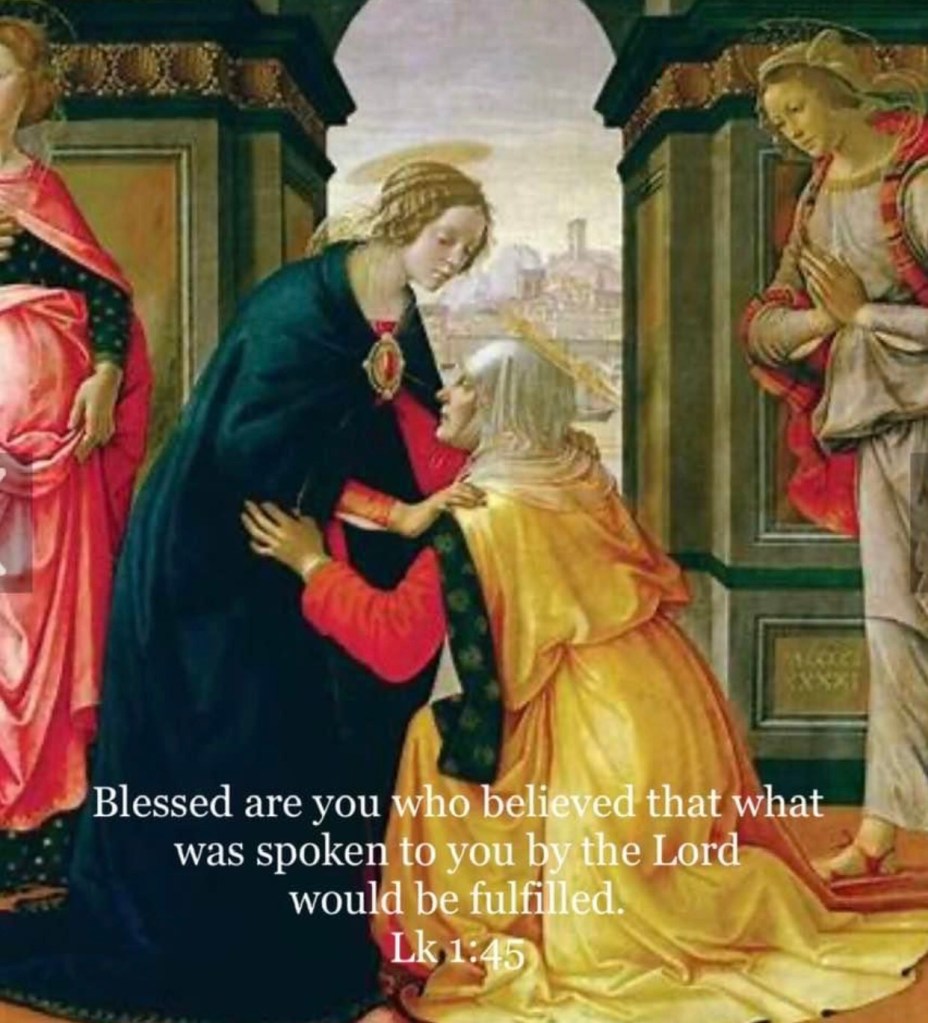
During the final days of Advent, we read one of my favorite scripture passages, Luke 1:39-45: The Visitation. In a series of verses just preceding this one, Gabriel announces it is Mary who has been chosen by God to bear the Christ and that her cousin, Elizabeth, despite her “old age,” is also expecting a baby (John the Baptist). Filled with the Holy Spirit, Mary “set out…in haste” (Lk 1:39); she ran (because the Holy Spirit is a Being of action and movement) to her cousin, literally to share the Lord with her and assist during the last months of her pregnancy.

When Mary arrives, Elizabeth, also filled with the Holy Spirit, immediately acknowledges her as the Blessed Mother and rejoices that “the mother of my Lord should come to me.” This is a joy-filled encounter of mutual recognition and thanksgiving. What’s more, Elizabeth not only hails Mary as the Mother of God, she also praises and blesses her for being open to and trusting Him, for it is only through Mary’s faith and fiat that God’s will is accomplished. Elizabeth rightly proclaims that Mary is blessed in her spiritual motherhood. Just as important, though, her fullness of grace is realized because she first “believed that what was spoken to [her] by the Lord would be fulfilled.” It is Mary’s faith and openness to God that leads to the fulfillment of our salvation.

We have made our way through Advent, filled with quiet and patient waiting for Jesus’s coming. Now celebrating the Christmas Octave, may we reflect on the glory and hope of Christ’s birth and remember the encounter of these faithful cousins. Open to God’s love and willing to trust and believe in His goodness, may they inspire us to repeatedly order ourselves to Him so as to fully participate in His salvific love.

What the Canaanite Woman Teaches Us

And Jesus went away from there and withdrew to the district of Tyre and Si’don. And behold, a Canaanite woman from that region came out and cried, “Have mercy on me, O Lord, Son of David; my daughter is severely possessed by a demon. But he did not answer her a word. And his disciples came and begged him, saying, “Send her away, for she is crying after us.” He answered, “I was sent only to the lost sheep of the house of Israel.” But she came and knelt before him, saying, “Lord, help me.” And he answered, “It is not fair to take the children’s bread and throw it to the dogs.” She said, “Yes, Lord, yet even the dogs eat the crumbs that fall from their masters’ table.” Then Jesus answered her, “O woman, great is your faith! Let it be done for you as you desire.” And her daughter was healed instantly (Matt 15:21-28).

Today’s reading is so rich, we can approach it from a myriad angles. This is a passage about how Jesus teaches us; about the perseverance of faith; about healing; about the Lord eventually spreading his Word to all peoples. In addition, because of some recent thoughts I bring to today’s reading, I am particularly focused on what this passage shows us about a mother’s love for and devotion to her child.

Today motherhood, indeed womanhood itself, is under attack. Childhood, for that matter, is prey to those who seek to destroy innocence as well. I cannot shake what I saw this week in the news. Health Secretary Rachel Levine praised an Alaska gender-affirming “care” clinic, seeking to replace the term “mother” with “egg producer,” “carrier,” “gestational parent,” or “birth parent,” and the word “men” with “XY individuals.” This facility also argues that the term “gender reveal party” be replaced with “embryogenesis parties” or “chromosome reveal parties” (https://www.dailymail.co.uk/news/article-12413023/Bidens-trans-health-secretary-Dr-Rachel-Levine-praises-Alaska-gender-affirming-care-clinic-wants-word-mother-replaced-phrase-EGG-PRODUCER.html).

What does this insanity have to do with today’s Gospel? If we are to return to the reality of who we are in Christ, we must be able to clearly see the culture for what it is, filled with chaos and lies, and then reject it, pointing instead to what is good, true, virtuous. It is tempting to reject the culture as ridiculous and unworthy of attention given these absurd arguments. But we would be naive and irresponsible to do so. Among the many terrible consequences of such language, perhaps the worst is that it is designed to dehumanize that human person. “Egg producer,” “carrier,” etc. are not only terms meant to foster a gender neutral society devoid of male and female, they are also distinctly utilitarian terms. They reduce the human being, in this case the woman, to nothing more than a flesh factory useful for and defined by her parts. (Pretty ironic given that the proponents of this ideology seek to persecute those who praise women for their physical attributes.)

To return to the Gospel, what is scripture teaching us about such matters? Here is a woman–not a birthing person, not a carrier–who is risking everything to help her child. She has left the comfort of her home and her people. In her desperate attempt to attract Jesus, the apostles become irritated with her and desire to send her away. Jesus, too, shows uncharacteristic indifference to her, likening her to dogs–Gentiles not yet worthy of His conversion. But there is more at work here. Jesus shows us time and again that our first interpretation is probably not the whole or even correct one.

Indeed, Jesus is not willfully uncaring or apathetic here. He recognizes this woman’s need from the beginning. Rather than a sign of indifference, Jesus’s silence, nay His seeming rejection, is actually an expression of love–a means of teaching her and refining her faith. Knowing her devotion to her child, He is testing and provoking her, and she responds by persevering and meeting the Lord where he seeks to take her. The Canaanite woman represents the heart of a mother who is willing to be humbled before God for the sake of her child. This is only the second example of Jesus healing from a distance, and it is the mother’s faith and her relationship with God that inspires it. Jesus teaches us through her example.

This passage exhorts us to ask, What do we believe about the virtue of life and motherhood? Are we glib and relativistic about it? Are we lazy about today’s language, shrugging it off as simply nonsensical and unimportant? Or in our desire to develop our relationship with Jesus, are we willing to become humble, express our vulnerability to God, and risk everything in an attempt to open our hearts, grow in our faith, and petition for the needs of others?

In today’s Morning Offering, Father Kirby likens the Canaanite woman to us as we journey in our “discipleship.” He explains:

The Lord Jesus…wants to teach us, guide us, take us deeper and deeper into what it is to love. He wants to refine our faith to such an extent that we know that we just have to be with Him. If He listens to us and grants our requests, if He makes things easy or difficult, if He blesses us with health and wealth or poverty and illness, that we will be with Him. The call of Christian discipleship is to be with the Lord Jesus, to be in His presence, to be His friend. St. Teresa of Avila says it best: ‘We worship the God of consolations, not the consolations of God.’ The Lord Jesus seeks to refine our faith–to draw us deeper and deeper into what it means to believe in Him, to be with Him….(https://www.goodcatholic.com/podcasts/morning-offering-with-fr-kirby/).

May we continue to learn from scripture how to be in the world–a world full of struggle and pain and difficulty, but one that also inspires us to return to what is true. The Canaanite woman shows us what it is to humble ourselves before the God who knows our hearts and seeks to heal us in all things. Let us pray that we might have her courage and be examples of true womanhood and motherhood for the sake of our children and the salvation of our souls.

Do You Know Who You Are? God Reveals Himself to Us in the Darkness

Father Blount reminds us that it is in the darkness, in our suffering, even when we feel abandoned and lost to ourselves, we are not orphans. We are His. We belong to God. Jesus tells us, “I will not leave you as orphans; I will come to you” (John 14:18). In our despair and loneliness, we might not see God. We might feel separated from Him. But Jesus reminds us, “Before long…you will see me. Because I live, you also will live” (John 14:19).

When it is dark, when we can’t see, let us cry out to God who is always calling us to communion with Him. He is with us. In Him we shall be made whole and be healed.

We are the Woman of Tyre

Jesus went to the district of Tyre. He entered a house and wanted no one to know about it, but he could not escape notice. Soon a woman whose daughter had an unclean spirit heard about him. She came and fell at his feet. The woman was a Greek, a Syrophoenician by birth, and she begged him to drive the demon out of her daughter. He said to her, “Let the children be fed first. For it is not right to take the food of the children and throw it to the dogs.” She replied and said to him, “Lord, even the dogs under the table eat the children’s scraps.” Then he said to her, “For saying this, you may go. The demon has gone out of your daughter.” When the woman went home, she found the child lying in bed and the demon gone (Mark 7:24-30).

When I read this Gospel early yesterday morning (2/9/23), it immediately resonated with me in a deep way, and I smiled to myself, understanding that God was speaking to my heart. 

Here is the Lord, wanting some time away from the crowds during His full days of ministering to them. In His humanity, we can imagine He is tired; He has been talking and healing for hours. But alas, this is not to be. A woman, a Gentile, no less, has found Jesus, followed Him into the house, and then falls “at His feet.” 

At first, He is noticeably a little irritated (although probably just responding in a clarifying manner) and tries to dismiss her. Jesus makes a comment about children and dogs, which scholars have argued has a variety of meanings, but ultimately suggests that He is at least appearing to be reluctant to help her. The woman, however, understanding His meaning, persists. Her love for her daughter is so great, her willingness to confront the Lord is so courageous and faithful, that Jesus cannot deny her. Even in this brief encounter, she and Jesus have formed a relationship—one of trust and love and faith. Jesus bears witness to the woman’s very real vulnerability, understands and hears her, and because of this frees her daughter from sin. 

How many times have we suffered for our children? How many hours have we worried, sought answers, and committed ourselves to doing anything we can to alleviate their suffering, pain, and struggle? How many late nights and early mornings have we sat in prayer, asking the Lord to deliver them? 

This mother in this story represents every one of us who has found the courage to become righteous warriors for our children—every one of us who is willing to go to the Lord, pleading for His merciful goodness and healing. It is not enough, however, just to ask for God’s help. Like this woman, we must remain determined to seek Him, follow Him, and then speak to Him with hearts fully open to His love. We cannot do this haphazardly. We cannot neglect Jesus for long periods of time and then only go to Him when we’re desperate. Of course, God can attend to us at any time. Even when we’ve been away from Him for a while, we can experience the healing of actual grace. But what this mother shows us is that when we are in relationship with Christ, when we are determined to find Him, be near Him, and ask for His understanding and help, He will always answer us. 

Although in this story Jesus was seeking time away from the crowds, He actually wants us to look for and find Him. In fact it is our very suffering that serves to draw us close to Him. He knows this, which is why, when we call for Him in our pain, He is there to comfort and heal us. 

At a time in our culture when women and mothers are often undermined and questioned, and when we sometimes ask ourselves if we have the courage to help our children through their sufferings, let this woman assure us we are in fact capable of doing just that. We cannot do it alone, however. As we cultivate our relationship with God, as we sit at the foot of the cross and integrate our pain with Jesus’s sacrifice, we are then in a position to best serve, care for, and lead our children. 

Mirroring the humility and faith of this woman and of course, Our Lady, may we continue to seek God’s love and goodness. May we pursue Him with courage and fierceness. And may we know when He answers us that it is our faith, born out of the crucible of suffering, that has saved us.

On Morning Walks, Geese, Flowers, and Discovering Oneness

I like to run in the mornings, before the sun gets too hot and the Mid-Atlantic humidity sets in. 

My route stays pretty much the same. I meander through various neighborhoods, down quiet winding roads, past farms and ponds where geese and ducks waddle around and swim, where swans glide with seeming effortlessness across the water, and then in the park where I follow a paved path, passing people walking their dogs, kids riding bikes, and older couples holding hands. 

My hours in nature have always been a refuge for me. I have discovered that time alone in the open air amidst the vistas of farmland, crossing tree-covered bridges, and running through the sun-dappled patches of grass and pebbles allow my soul to breathe. I have always needed solitude and space. I had a therapist ages ago who said to me on my first visit, “You may be small, but you need wide pastures.” He hit that existential nail on the head. Rainy days in the park are the best. It is often expectedly empty. All the smart runners stay home and dry. Every so often, though, I will see another dedicated runner across the field, and I am (ridiculously) disappointed. Rats, I say to myself. I thought I was alone.

Every time I venture outside for my walks and runs, I learn something new or see something new or think about life in a new way. This is the gift of nature, as many teachers before me have witnessed. Franciscan priest, teacher, and modern-day mystic, Richard Rohr, teaches that (as St. Francis himself believed) nature is the first true scripture. This resonates with me deeply. All of life, its challenges and sufferings and pain and beauty and wonder and joy, is reflected in every element of nature. Every budding wildflower. Every nascent pine cone. Every intricate gossamer-like spider web. They all reflect the spirit of the cosmos.

And so it was again for me today. As I ran down one of the quiet roads past a pond, I could hear the geese in the distance. As I approached the pond, there they were, visiting and swimming and seemingly enjoying the morning. Soon afterwards, I heard mourning doves, cooing and chatting as they do. And then I saw them, sitting happily on a wooden fence, and as I approached, they flew away to perch on a tree branch. 

Then quite suddenly, I ran through a veritable valley of perfume. The air was saturated with the scent of honeysuckle and roses. It nearly took my breath away with its beauty and perfection. The fragrance of flowers hovered around me like a morning mist, but invisible to the eye. And it was this inability to see the source of such sweetness that actually heightened my awareness and appreciation of the moment. 

I searched around me, but I saw no honeysuckle bushes, no blossoming roses. Unlike the geese and mourning doves that had made their presence known to me, the flowers remained allusive and intangible. 

And yet, their perfume affirmed their presence. The joy I felt in being cloaked with their scent was palpable and real and true. Because I felt this deeply, I also trusted they were there around me, somewhere. This knowing was enough. This satisfaction and engagement with ethereal and unseen beauty was enough.

Almost immediately, I realized that this seemingly mundane experience was no less than an affirmation of, and invitation into, deeper faith. Faith in what? In knowing that the “energy that creates worlds” (Abraham) is around and in us at every moment. That God, Source, unitive consciousness, are present in the eternal now, which is the continual outpouring of “beingness” itself. “Faith,” as Abraham tells us, “is believing in something before we see it in its manifested state.” In other words, it is the knowing that the thing, the event, the person, the opportunity are here for us, available to us, even if and when we can’t see them—yet. 

I heard the geese and doves and then I saw them playing before me. As we learn to trust and as our faith grows, it is important to have these experiences where the invisible is easily manifested. These experiences teach us to trust our faith—trust our knowing. We learn that we need not second-guess ourselves, fear that what we envision or feel or desire won’t come. These easy, quotidian experiences smooth the resistance along our spiritual paths. We can meditate on a blue bird or on our dream job. We can contemplate a happy interaction at the market or the resolution of illness. They are the same things where energy is concerned. The only question is, am I resisting the manifestation because I don’t believe it will come? Because I don’t have faith?

So when I experienced the honeysuckle and roses and didn’t literally see them, I smiled. I was satisfied, because I knew they were there. Their perfume was a gift—a glorious reminder that I can feel deeply, have a high vibrational emotional response without needing to see the flowers themselves. 

These are the everyday moments we are invited to experience and contemplate and in which we can find meaning. “Everything is spiritual,” as Rob Bell writes. “Experiential salvation,” as James Finley when discussing mysticism explains it, is all around us in the world if we choose it. “The fiery power [of Divine love] is hidden in everything that has being,” as Hildegard writes. 

I will continue to take my walks and run outside. I hope you find ways to move meaningfully through nature, too, wherever it takes you. The mysteries are always calling us. Spirit, faith, love are always beckoning. Can we try and consistently experience the perfect perfume of a flower and be satisfied, even if we can’t see it? When we can, and the more we can, we will understand that we are truly powerful co-creators in this interconnected universe that is ever unfolding within and around us.