Jesus Heals Through His Humanity

During the month of July, Catholics celebrate the Precious Blood of Jesus. We are invited to contemplate our Lord’s sacrifice—literally the pouring out of His life force for all of humanity itself. It seems timely, then, that on the eve of this devotional time in the Church, we read from Mark about Jesus’s encounter with Jarius and the woman suffering from a hemorrhage. Why timely? Because this story, which in its graceful arc intricately and artfully entwines two distinct and co-equal plots, highlights our Lord’s humanity. Yes, it is His divinity that miraculously heals. But it is Jesus’s willingness and desire to physically and emotionally encounter the other in his and her humanness that ultimately invite and allow for physical and spiritual restoration.

In Mark 5:21-43, the narrative is shaped and informed by physicality. The crowds are loud and chaotic as they press on and push against Jesus, and even the private moments are characterized by tender physical intimacy. Integral to Jesus’s humanity is His attentive listening. This “human skill,” this “fruit” that defines Christ’s “path,” becomes and forms the path of the story itself (Spiritual Direction Certificate Program, 2019, p. 1).

Jairus appears, begging Jesus to heal his dying daughter. Jesus immediately answers this call into relationship with him, “leaving [Himself] behind…[and] entering fully into [Jairus’s] narrative” (Spiritual Direction, et. al., 2019, p. 1). The woman is introduced amidst this chaos, and the story shifts. Faithful despite her suffering, she is drawn to Jesus’s humanity. He is moving away from her, mobbed by followers, but she pursues Him, believing, “If I but touch his clothes, I will be made well” (5:28). As soon as she touches Jesus, He not only enters her reality, into relationship with her, He “becomes” her reality. “Immediately her hemorrhage stopped,” and Jesus was “[i]mmediately aware that power had gone forth from Him” (5:29-30). What’s more, to the incredulity of His disciples, He asks who touched Him. Jesus questions not only to “listen to others,” but also to form relationships with them—“to hear and explore what is on the other’s heart and mind” (Spiritual Direction, et. al., 2019, p. 1). The woman, knowing “in her body that she was healed” (5:29), could have quickly exited, but Jesus calls her to Him, her former unclean “qualities fad[ing] into…insignificance” (Van Kaam, 1996, p. 19). 

It is also significant that the woman’s hemorrhaging blood simultaneously represents the essence of her societal “uncleanliness” as well as the life force that had been draining from her for years and causing her terrible suffering. Both her status as an outcast and a woman in constant pain results in her separateness from others—physically, emotionally, and spiritually. It is in Jesus’s vibrant humanity, however, that He stops the purging of this life force, returning not only her body but also, because of her faith, her spirit to right order.

While Jesus is still speaking to the woman, we are suddenly thrust back into the clamoring crowd. People are telling Jairus the girl is already dead. Hearing or ignoring this, Jesus comforts him “with reassurances of His love” (Acklin & Hicks, 2017, p. 52). Taking only Jairus, Peter, James, and John with Him, Jesus is again immersed in suffering: “weeping and wailing” at the girl’s house. He invites the family to believe the child only sleeps, but they reject this offer of faith, laughing at Him instead. Jesus’s rises up in the strength and tenderness of His humanity, sending them away, and moving towards the girl, into the sanctum of her room (of her being). His actions say, “[L]et me concentrate on giving you my entire attention” (Sullivan, 2000, p. 126), and He calls her into relationship with Him, commanding, “Talitha Cum” (5:41). This healing, unlike that of the woman, is intensely private; Jesus instructs the parents to tell no one. His humanity is delightfully lastly revealed when He pragmatically tells the girl’s parents to “give her something to eat” (5:43). Like her soul, her body requires nourishment, as well.

These stories prompt us to ask, When we suffer, will we have Jairus’s courage to beg for Jesus’s help? When we experience severe emotional and physical pain, will we persevere as the outcast woman, crawling through the crowd to touch Jesus’s garment? Let us pray that indeed we will. As our faith deepens, may we understand that the “human encounter” with Jesus is “the essence of cure in the deepest sense,” and that He calls us to Him through the fortitude of faith (Van Kaam, 1996, pp. 19-20).

Acklin, T., & Hicks, B. (2017). Vulnerability. In Spiritual Direction: A Guide for Sharing the Father’s Love (pp. 49-74). Emmaus Road Publishing.

Spiritual Direction Certificate Program (2019). What Does It Mean To Listen? (p. 1). Unpublished. 

Sullivan, J.E. (2000). The Healing Power. In The Good Listener (pp. 124-128). Ave Maria Press.

Van Kaam, A. (1996). Counseling and Psychotherapy as Human Encounter. In The Art of Existential Healing (pp. 15-40). Dimension Books.
Aim High and Move Forward

The purpose of life is not to get everything we want. The purpose of life is not to make sure the waters we sail in are smooth all the time. The purpose of life is not to live free of pain and suffering.

The purpose is to become all we can be, to contribute to the world in a meaningful way, to make life better by becoming the best version of ourselves.

How do we do this? Aim high, reach, stretch, and look forward, and do all of this with as much goodness, kindness, and commitment to Truth as you can muster.

What if the mark I’m aiming for isn’t high enough? What if I fail? What if I’m wrong?

So what? The meaning is in the trying. The purpose is to pick something and go for it. Each step will lead to another and another and another.

It is not in the goal that the meaning of life appears. It is in the moving towards it that we uncover our purpose and new ways of expanding and evolving. It is in the inspired action that we discover our true strength.

The Transcendentals and Philosophy

Why philosophy?

Recently many of my thoughts have been devoted to the contemplation of the Three Transcendentals: Being is defined by what is good, true, and beautiful. And as often occurs when one is particularly mindful of an idea or theme, it is showing up seemingly everywhere. I’m hearing the Transcendentals in videos and lectures, reading about them in literature and essays. Clearly, my attention is tuned to aligning with them in a variety of forms and media.

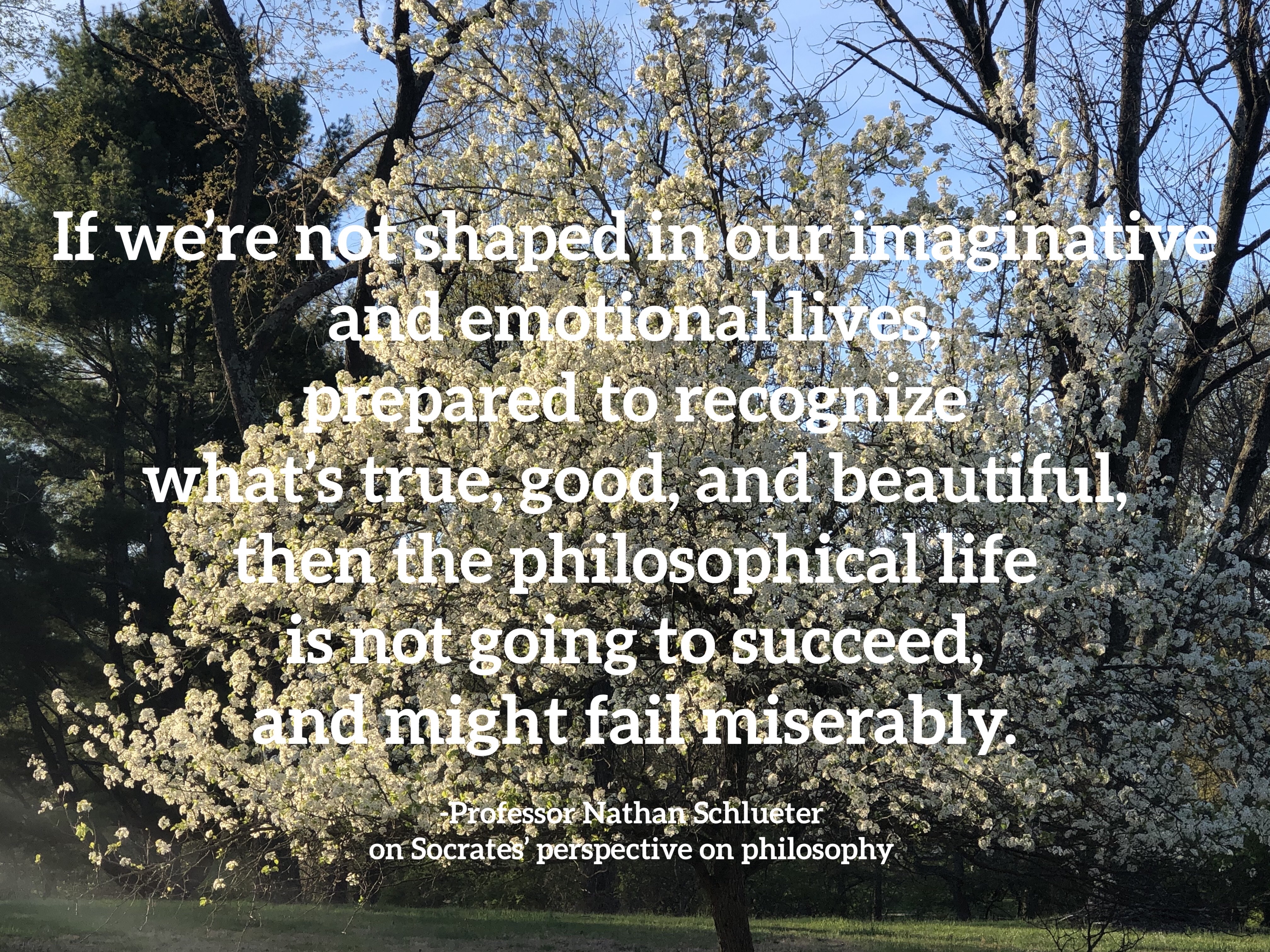
I share this quotation from Hillsdale College’s Professor Schlueter, which he offers in an inspired online class on Western Philosophy. (If you are interested about such things, I highly recommend it!)

Sit with it. Contemplate it. Does it resonate with you? How does it influence how and what you think?

Oneing with the Sunset

Being reveals Herself in all things.

Our soul is oned to God, unchangeable goodness….(Julian of Norwich)

At a time when we are surrounded by cynicism, when we often feel there is no absolute truth, when everything from politics to religion to education seems upside-down, it’s easy to lose faith and hope in who we are, both as individuals and as a people. BUT here is an anecdote that re-inspired my belief in the goodness of beingness. Yes, it’s a small example, but perhaps it can remind us that when watch and listen for the delicate and profound essence of life, it will reveal itself.

Tonight I decided to walk westward on the promenade in Cape May to catch the sunset. As I approached the end of the walkway that opens onto the beach and reveals a view of the Cape May Lighthouse at the Point, I realized the sun was setting rapidly and I might miss it. I ran to find a spot where I could stand and video the event. And in so doing, I witnessed something wonderful: throngs of people watching and waiting for the blood-orange red orb to drop below the horizon as the lighthouse standing before it stoically shone its great rotating beacon. As the sky turned a Monet palette of red, yellow, violet, and pink and the sun slipped away, people cheered, car horns sounded, and I cried.

Why? Why did we all rally to witness this everyday event? What does this say about us?

I believe, even sometimes in spite of ourselves, we know what’s important. We know what’s truly meaningful. We inherently know what’s good, beautiful, and true (the Three Transcendentals). The sun setting occurs every night, but we know not to take it for granted. Our hearts comprehend the beauty and awe of this event.

For those of us who don’t believe in a higher power, we appreciate the beauty of the colors and the awesomeness of planetary movements.

For those of us who believe in God or Source energy, the sunset is a true manifestation of the Divine, which lives and breathes and moves in all things. It humbles and embraces us. The Divine invites our spirits to merge with Hers, into Herself, feeling a oneness with this sublime eternal energy.

Regardless of why we all gathered tonight to celebrate the sun setting on this Easter Sunday evening, I am grateful to have borne witness to the magnificent sky and to the crowd who cheered it. May this feeling linger in our hearts and inspire us to seek and appreciate all the moments in life that fill our souls with wonder.

What I Know Right Now

Having lived (and continuing to live) through my fair share of challenges, which is basically the essence of the human condition, this is what I know. Whether we are aware of it or not, we co-create our every experience, and each one is an opportunity to learn more fully how to see and feel, indeed to evolve. Every interaction with life is an invitation to perceive the world and understand ourselves with greater clarity, depth, and breadth.

All suffering comes from a belief system based on lack and fear. Are challenges certain? Yes. Are illness and death possible and true? Yes. This is life. As soon as we are born, death is inevitable. But every moment we are alive, we have a choice. Regardless of the form life takes, we have the freedom to choose our perspectives and our attitudes.

Only when we can see conditions as they are and detach from them will we be able to discover peace. At any given time, we are able to perceive only a portion of the myriad energies, life purposes, and evolutions occurring around us. Our task is not to control or change others or the conditions in order to find satisfaction and joy. Rather, it is to surrender to what is and allow the natural flow of life-force energy and infinite possibilities to move through and elevate us.

Somehow we have come to believe that contrast and pain are bad things that need to be quashed, eradicated. This is understandable. Emotional and physical pain hurt. We don’t like them. We are intelligent creatures, but our desire to evade and eliminate pain is primal. Our entire system is designed to survive, after all, and pain (and the mere threat of pain) is potentially deadly. But we are more than our neural pathways and our brain. We are spiritual beings first. So our instinctive “belief” (which is in truth taught to us) that adversity is “bad” is actually incorrect. It is misguided. It is a misperception. All creation occurs in the contrast. It is the only place creation happens. Nothing expands without breaking open. Nothing. In denying this truth, we reject our own evolution. Our nature is to crave expansion. But we’ve individually and collectively convinced each other that the pain, the very opportunity to create, is inherently random, unfair, and unnecessary and is to be avoided at all cost.

So what do we do? We repress, medicate, blame, victimize, and argue for our crappy, sad, miserable lives. We say we are debilitated by anxiety and fear. No! We are debilitated by our inability to welcome and allow what wants to be born and express. Anxiety, depression, worry, fear–these are signs of life yearning to move through us, and, because we believe them to be signs of our brokenness, we suppress them. Why do these low but powerful vibrations increase? Because we insist on shutting them up, pushing them down, and arguing that they are the problem. Our spirits want to live. They want to be free. And we protest, claiming our fate as prisoners. We demand the chains are real. So we remain in our emotional cages, for which we blame others, but in fact build and reinforce ourselves.

It’s nothing less than tragic that so many of us argue with nihilistic certainty that it is the prison, not the free spirit, that is real and where we deserve to live. The seduction of the darkness is powerful, indeed. As in Plato’s allegory, even if one finally escapes the shadows and lies in the cave and experiences the light of truth in the sun, the collective insistence on perpetuating the lie is usually so strong that it can do nothing other than destroy the truth and anyone who speaks of it. And so we choose to remain in the cold, fear-based cell of the dark.

We need to know the light is there, waiting for us. Will you choose different?

Be Unconditional

Two trees stand side by side, tall and adorned with the saturated brilliance of autumnal golds and oranges and reds. Here, in this field, they exist, just as they are, strong and true. But today, the sky is grey. The clouds cloak the sky, momentarily hiding the sun, as a mother hangs a curtain over a bright window to allow her babe to sleep.

Unlike the sleeping baby, though, the one tree is sad. It misses the warmth and brightness of the fall sun. It feels a chill in the air and regards the smoke-colored sky as unjust. It says to the other tree, “How am I to endure this depressing sky? It is making me so very sad. I am a tree, strong and beautiful with leaves the colors of jewels, but not today. How can I express my beauty when this infernal grayness dims me so?”

The other tree responds, “What is this you say? How is it that the sky depresses your color?”

“Isn’t it obvious?” the other tree answers. “My leaves are dull; I need the sun to shine upon them so that everyone might see how brilliantly colored they are. Without the light I am nothing.”

“I see,” said the other. “That does sound very grim, indeed. I can understand why you feel so sad. I wonder, how do I look to you? Do believe the clouds darken my appearance too? Is my beauty so censured by the gray sky?”

“Oh, I assure you, you are still beautiful,” answered the tree. “Clearly, you are different and cannot be influenced. Your leaves are as lovely as ever. In fact, the grey somehow enhances your beauty. The colors are changed somewhat, indeed, but their hues are true and rich. You are clearly luckier than I, to be sure.”

“That’s interesting,” answered the other. “So, I seem unchanged to you, but you feel different and reduced by today’s weather?”

“I will tell you this, friend,” she continued. “Even today, when the clouds hide the sun, when the autumnal light is faded, you are still brilliant and beautiful. You might not be able to see it in yourself, but I can, just as you see it in me. And this is why. Whether the sun shines on us or the clouds roll across the sky to cover its light, we still stand as we are. The conditions of the air, this field, the animals in it, everything around us–they do not dictate who we are, how we stand, and the color of our leaves. Yes, when the sun warms us and ignites our color, our beauty is undeniable to all who see us. But when it does not, we are not less magnificent. We are what we are, unconditional in our being. As long as we stand here in this field, for as many decades or centuries as we are in this place, all we need to know is this: to live independent of conditions is the only way to true joy, which is our very birthright, given to us by Nature, herself.”

“It is alright to feel sad. It is understandable to witness how conditions can alter how we feel about ourselves. But just remember, your truth does not depend on anything outside of you. In your very nature, you are as an extension of the universe itself, which is ever only abundance and love and eternal beauty.”

The sad tree listened and accepted these words. The cool breeze rustled through her color-soaked leaves and she looked up at the passing clouds. She knew all of this to be so. And she was able to rest in this truth.