

Blog
Wisdom From Pooh Bear
“I always get to where I’m going by walking away from where I’ve been.”
—Pooh Bear, Christopher Robin
I took the children to see Christopher Robin on Sunday. It was delightful and happily speckled with many Pooh-isms. The above quotation was one such little jewel of wisdom. More than once, my brain was buzzing with so many insights and thoughts that I snuck out my phone in the dark theater to take notes.
As are most of Pooh’s sentiments, this one is simple but not simplistic. Wisdom teachers tell us it is not just the goal, the desire, the vision, the intention that we must determine. It is as, if not more, important that we also allow this newness to align with our energy. In other words, we must attune ourselves to the channel that is broadcasting this abundance and is just waiting for us to see it. We can wish for and intend something all we want, but if we are not mentally, spiritually turned towards the creative spark and flow that will deliver it, we will never actually manifest it.
“Walking away,” then, as Pooh tells us, in fact represents this Art of Allowing, as Abraham Hicks titles this action. We are to move away from the old self, the ego, the limited, lacking energy and move towards the abundant, the beautiful, the easy, the flowing, the joyful.
It was no less than Einstein, who using his tremendous brain and intellect, declared this statement in the same vein as Pooh’s: “We cannot solve a problem with the same consciousness that created it.” In other words, we must turn away from old patterns and ways of thinking and realign our consciousness so as to see challenges and opportunities in new ways.
Pooh Bear often modestly states that he is a Bear of “very little brain,” but I think we know different, don’t we? And even more significantly, Pooh’s friends, including Christopher Robin, tell him often that he is “a Bear of very big heart.” Of course this makes perfect sense; many teachers, like Joe Dispenza and others, have proven scientifically that when the heart and brain are in coherence, energy and abundance flow effortlessly.
I did not expect to feel so many emotions at the movie theater on Sunday. But life is like that when we try to live with open receptive hearts and minds. Whether the wisdom comes from learned teachers or little bears, I’ll take it. Like Pooh’s beloved honey, this spiritual, soulful goodness is delicious and nourishing. It is everywhere if we are open to witnessing it.
Coconut-Nut Rounds

I make nut butter at least several times a week. For a while I was sticking to hazelnut butter (and I’d make a chocolate version, too), but now I’m reincorpirating almond butter into my repertoire.
We also love coconut around here, so while I have the food processor out on the counter, I also try to throw together some raw coconut macaroons or coconut-nut rounds.
Here is an easy recipe for the latter that incorporates either your homemade nut butter or your favorite store-bought variety. Store these rounds in an airtight container or glass jar at room temperature for up to one week.
In the bowl of a food processor fitted with the metal blade attachment, combine about 1/2 cup of organic almond or hazelnut butter, 3/4 to 1 cup of organic unsweetened shredded coconut, 2 teaspoons of granulated monk fruit or raw honey (optional), 1 teaspoon of organic coconut oil, 1/2 a teaspoon of vanilla extract, and a pinch of salt. Process until the mixture just begins to clump or hold together when you squeeze a bit in your hand. If it’s too dry, add a bit more coconut oil until you reach the desired consistency.
Transfer the mixture to a bowl and form into walnut-size rounds. Roll in additional shredded coconut, if desired.
Makes about 12 rounds.
Maybe the Most Important Question
At the end of the day, perhaps the most significant question we need to ask ourselves is this: Are we letting the conditions around us dictate how we feel?
We must learn to remain observers of our circumstances. It’s challenging at first, but we must understand that every event is neutral, and it is our perception of them and the stories we tell about them that infuse them with meaning. Only when we learn to detach from the duality that demands we name an event or person “good” or “bad” will we realize true freedom. This non-dual position prevents us from remaining a servant to our egoic reactivity, and instead empowers us to decide for ourselves how we want to show up in the world.
It is not the conditions of life that dictate who we are; it is our alignment with source, and the extent to which we are allowing our souls to attune to this high vibration, which ultimately determine who we are and how we feel at any given moment.
How We Talk to Ourselves Matters
Evidence is showing that how we feel about our bodies and ourselves as a whole is a result of our self-talk l. Do we chastise our physical bodies? Do we tell our bodies we hate them? That they are unattractive? Are we angry with them when they don’t perform the way we want them to?
Do we tell ourselves we’re not enough? Or worse, do we tell ourselves we’re stupid or unworthy?
Take 30 minutes or so to watch Dr. Kim D’Eramo in this video and then ponder some of these questions.
It’s remarkable how our mental health and bodies “improve” when we treat ourselves with love and compassion.
How Wimbledon, the Duke and Duchess of Cambridge, and a Serbian Tennis Champion Inspired Me to Think About Non-Duality and Formlessness
I have had so many thoughts this past week after being riveted by the fierce athletes who competed in the semi-finals and final at Wimbledon 2018. I could write about sports and the inspiring role they play in my life. I could dive into the ways witnessing this level of competition sparks the creator, athlete, and spiritual warrior in me and helps me to connect to my own true essence.
But what has me thinking deeply at the moment is the discussion many of us are having these days around form and formlessness; around non-duality; and around living in spirit and simultaneously playing with the tangible stuff of life.
During the final days of Wimbledon, I heard comments from ESPN talking heads, the likes of which I never before experienced. They discussed the mind-body-spirit readiness of the players. They talked about tennis as a mental game and how the body follows the level of spiritual preparedness. Wow. I don’t think they were talking like that five years ago.
When we discuss form and formlessness, I often feel that we give the former a bad rap. It’s easy to roll our eyes at it, as though it’s simplistic and shallow and representative of egotistical materialism. Many of us seem intent on avoiding form, as we raise our gaze to what we believe are the more elevated complexities of formlessness and spirituality.
I admit, as much of a seeker of non-dualistic truth as I am, I have always loved the form of elegance, tradition, and excellence, the likes of which Wimbledon exemplifies. I remember being a kid and sitting entranced in front of the TV for hours as Boris Becker, the then strapping red-haired German, played in his first Wimbledon final. Perhaps I was a tennis player in another life, who knows? Or maybe my fascination stems from somewhere deep in my DNA. Recent testing from 23-and-Me reveals that most of my genetic make-up originated from the United Kingdom. I’ve always been an Anglophile. And I’m hardly alone in having at least a passing fascination with Meghan Markle and the ever-impressive Duke and Duchess of Cambridge, who in the Wimbledon stands, were unabashedly gorgeous. This is the pretty, fun, and for most of us, the fairytale stuff of life.
As all of these ideas and thoughts swirled through my head, they eventually coalesced into a synchronistic theme when I watched Novak Djokovic battle to win Sunday’s final against Kevin Anderson. Here is where the inspiring dance between form and formlessness became clear.
In form, Djokovic is nothing less than awesome. He is a handsome, Adonis-like figure, who is as beautifully spoken as he is a skilled and warrior-like athlete. Djokovic, whom I heard interviewed months ago, truly represents how to live in non-duality.
When interviewed after his win on Sunday, he spoke fairly openly about the difficulties he’s experienced these past two years. From major injuries to surgery to staying off the court for six months to doubting his own ability to return to world-class rank, he was vulnerable and truthful. And what did he say about this? He said, “You have to trust the process. You have to let life arrange things around you.” Here is a man who in form just achieved one of the greatest wins in his sport, and he’s emphasizing “the process.” Stunning.
He then went on to talk about how moved he was to have his young son in the stands, watching as he received his trophy. He talked about how for the past couple of years, his son inspired him and that how hoping to share this moment at Wimbledon with his boy encouraged him to play as hard as he did. This is what this warrior said about his child: “My son can teach me; he is my little master. He can teach me how to move on, how to forgive, and how to live.”
To me, this is the dance between form and formlessness. This is the elegance and inspiration of non-duality. We must live consciously, always mindful, always seeking, and always open to truth and authenticity. We must be willing to allow suffering to ebb and flow, but never to permanently pull us into victimhood. With this insightful conscious, we too can become warriors and powerful manifestors in our own lives.
We can love and play with and yet remain ultimately detached from form. We can enjoy the wonders that are our children, while understanding that they are here to teach us as much as we are here to help shepherd and encourage them.
Thank you, Novak, for being a spark of inspiration to so many of us seekers, both on the sporting battlefield as well as in the spiritual playground that is everyday life and consciousness.
Birthday Brownies

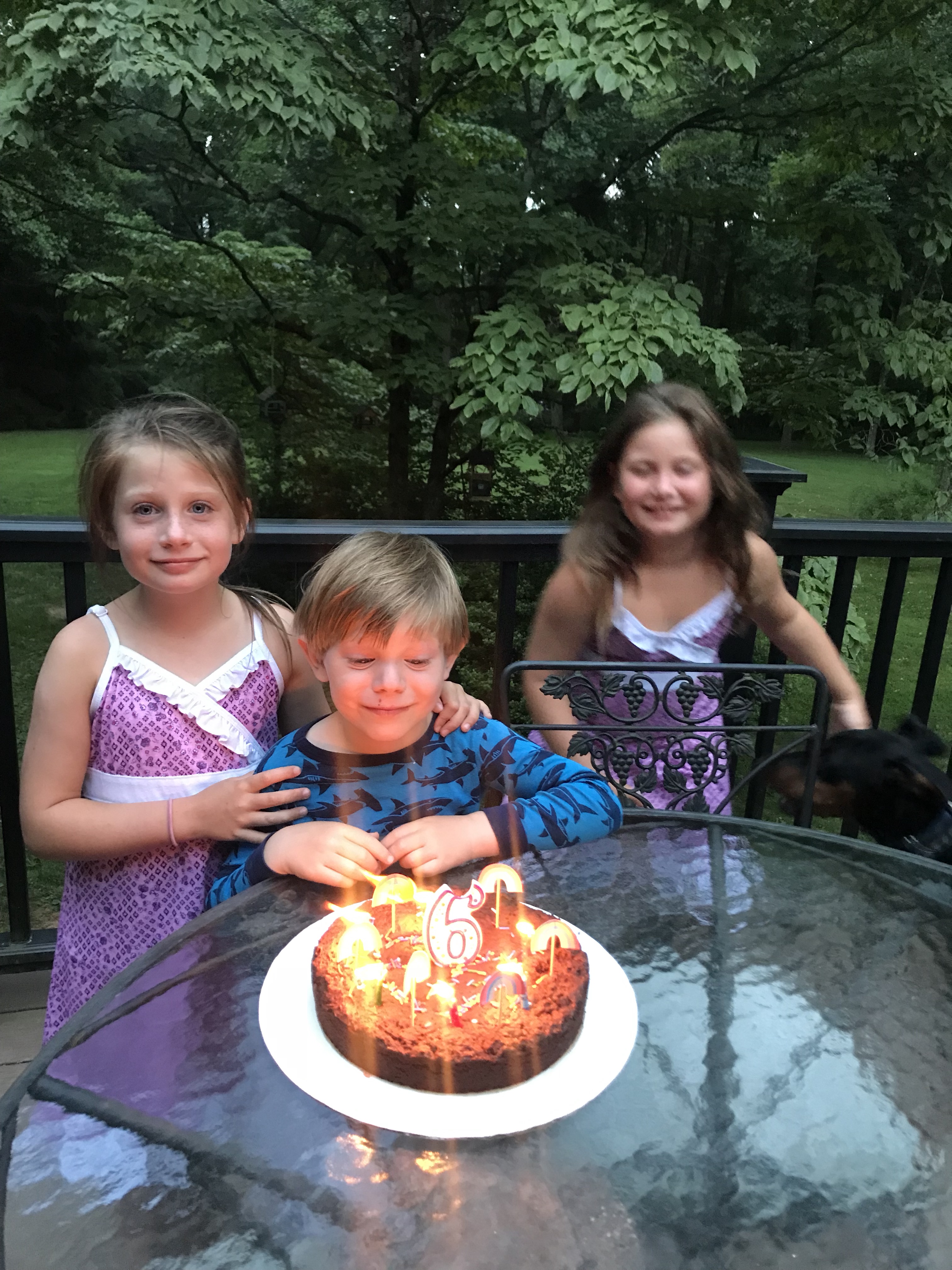
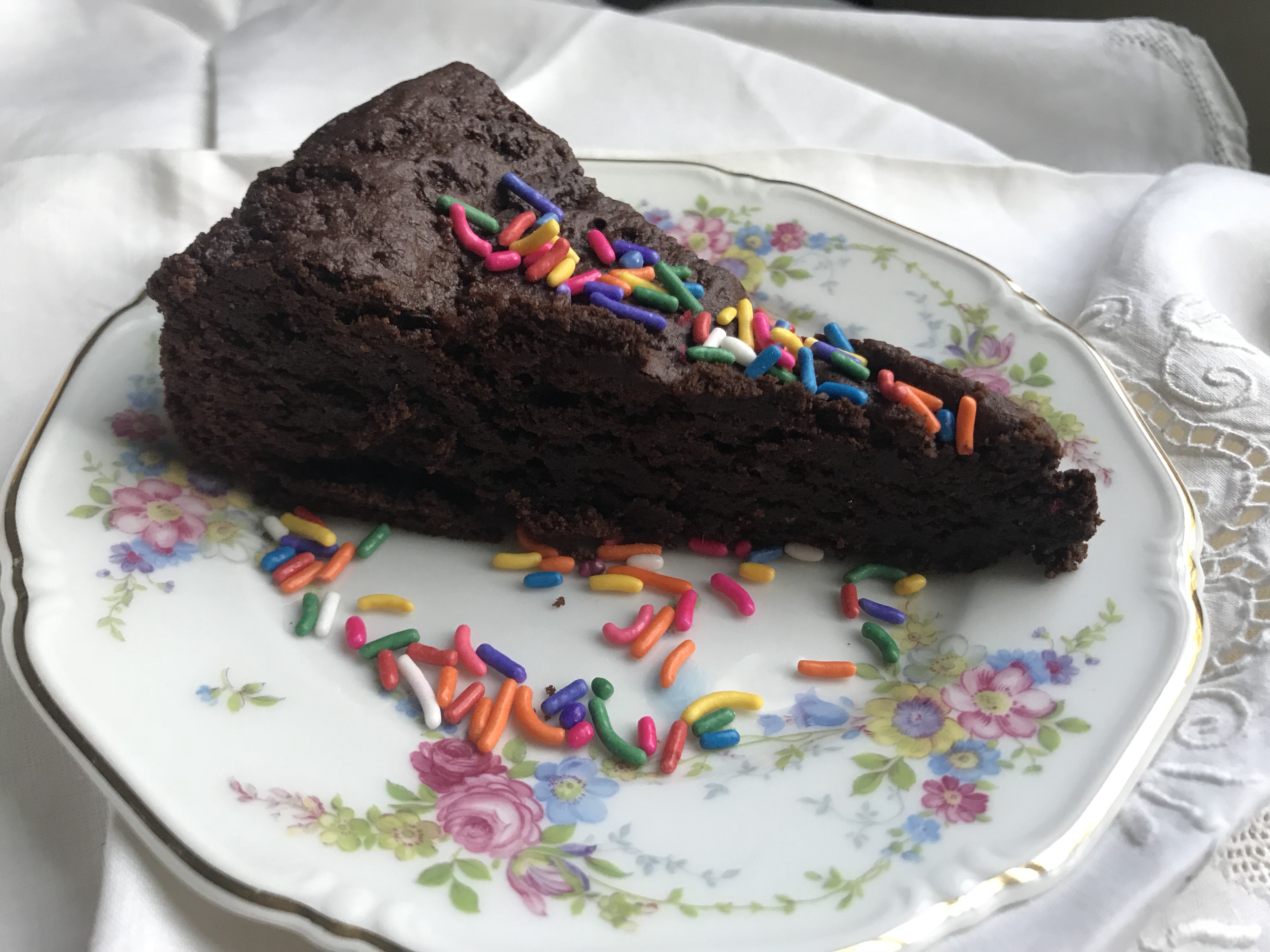
The story of the birthday brownies goes like this.
Sean’s sixth birthday was similar to every other summer day. It was filled with camp and swimming and made even busier by appointments for the kids I scheduled months ago.
I had lots of cool presents. But I hadn’t wrapped them.
I had started a cake—three tiers of chocolate gluten-free deliciousness—but I hadn’t assembled it yet with frosting and decorative doo-dads.
So by the evening of Sean’s birthday, I was scrambling a little more than I had planned.
Since the grandparents wouldn’t be seeing us until at least the next night, I suggested we save the cake and I make a quick batch of brownies. All three kids agreed this was a swell idea, and so I proceeded.
I like this recipe, because it comes together quickly in the food processor and bakes in about 20 minutes. This recipe is gluten free, but you could certainly play with the fat here (instead of organic butter, use coconut oil) and even the eggs (use your favorite egg substitute).
These brownies have a slight cake-like texture and are also moist. They are delicious warm, right out of the oven and as we discovered, are even worthy of birthday candles.
Makes one 9-inch pan
In the bowl of a food processor fitted with the metal blade attachment, combine 1 cup of dried pitted dates, 1 cup of raw sugar (or a combination of raw sugar and coconut sugar), and 1/2 teaspoon of sea salt and process until well combined and crumbly. (There should be no visible large pieces of dates.)
Add 3/4 cup of melted organic grass-fed butter and 3 organic eggs and process until well combined, stopping occasionally to scrape the sides of the bowl.
Add 2 cups of sorghum flour, 1 1/4 cups of organic cocoa powder, and 1 teaspoon of baking soda, processing to incorporate.
Remove the bowl from the machine and stir in 1/3 cup of dairy and sugar-free chocolate morsels, if desired.
Transfer the batter to a 9-inch buttered parchment-lined and floured round or square pan. Bake for 15 to 20 minutes at 350 degrees, or until a wooden skewer inserted in the center comes out with a few crumbs adhering to it.
Set aside to cool slightly, before turning out onto a cake plate.
Look to Yourself First
No matter what we’re dealing with in life—a difficult spouse, parent, friend, employer, experience—the answer to the challenge is always the same. We must look to ourselves first. The issues we need to address never exist “out there,” but rather rest in our core authentic selves.
It’s so easy to point to the outside source and blame it or him or her. Yes, perhaps there is a person triggering us. Maybe an experience did cause us pain.
But here’s the key: when we are able to view all triggers as neutral, as non-dualistic, we are in a position to release discomfort or even literally disease, and begin healing.
As Little Shaman discusses in this podcast, all things show up in our lives (we actually co-create them) to reveal to us something we need to learn. All experiences, especially “negative” ones, are teachers.
The question is, will we continue to suffer and be triggered and victimized, or can we shift our focus and attention enough to detach from the source of pain and look inward?
Only self-reflection and contemplation and commitment to fine-tuning our own consciousness will lead to physical, emotional, and spiritual evolution.
Learning to Refocus
A recent presentation by my friend and mentor, Suzi Kesler Lula, inspired my brain to fire in many directions. I have had many thoughts. Here is one observation.
For years, I have been saying (without any research to back this up) that when I (we) are down, cranky, can’t get out of our own way, we need to find a way to shift and refocus. Many thinkers and spiritual leaders express this, from Dr. Shefali to Eckhart Tolle to Abraham Hicks. This seems obvious, but when we’re in the moment of super-cranky-upset yuck, it can be so challenging to move our attention. Our ego, our hurt self, is saying, “What the hell? No way. I’m feeling gross and victimized. Get the unicorns and rainbows out of my way before I scratch your Pollyanna eyes out.”
So, first step is to be prepared. We need to know in ADVANCE of our mood swings what we’ll do when we get triggered.
For me, beauty has always been a go-to. Suzi’s recent discussion of the importance of music (and Dr. Shefali’s discussion of her recorded sessions to herself) prompted me to share this. Whether it’s art or music or flowers or even window shopping in beautiful stores, beauty, which to me is really a reflection of excellence and creativity, helps me shift my attention.
Suzi Kesler Lula mentioned that certain music has a very high vibration. Again, I knew this intuitively, but hadn’t put words to it. Music is so subjective; what genre one person loves might put another to sleep or even agitate her.
For me, the Baroque: Bach, Telemann, Handel, Vivaldi, etc., have always spoken to me profoundly. I start to cry during some of these pieces. The hair on my arms stands up and I get goose bumps. My entire being elevates. I have responded this way as long as I can remember. This resonance is just a part of who I am. Now I know that this is because for me, this music resonates at a very high vibration and speaks to the purest part of my soul. I have been telling my children for years that elevated music is good for their brains; turns out it is, and it nourishes their entire beings as well.
Art is SO important in refocusing us. Whether it’s art we make ourselves or participate in by being observers, it is essential to keeping us grounded and at the same time, elevating us into a sphere that is purely spiritual, essentially energetic, and without form.
Sugar Scrub: A Healthy Way to Enjoy Sugar
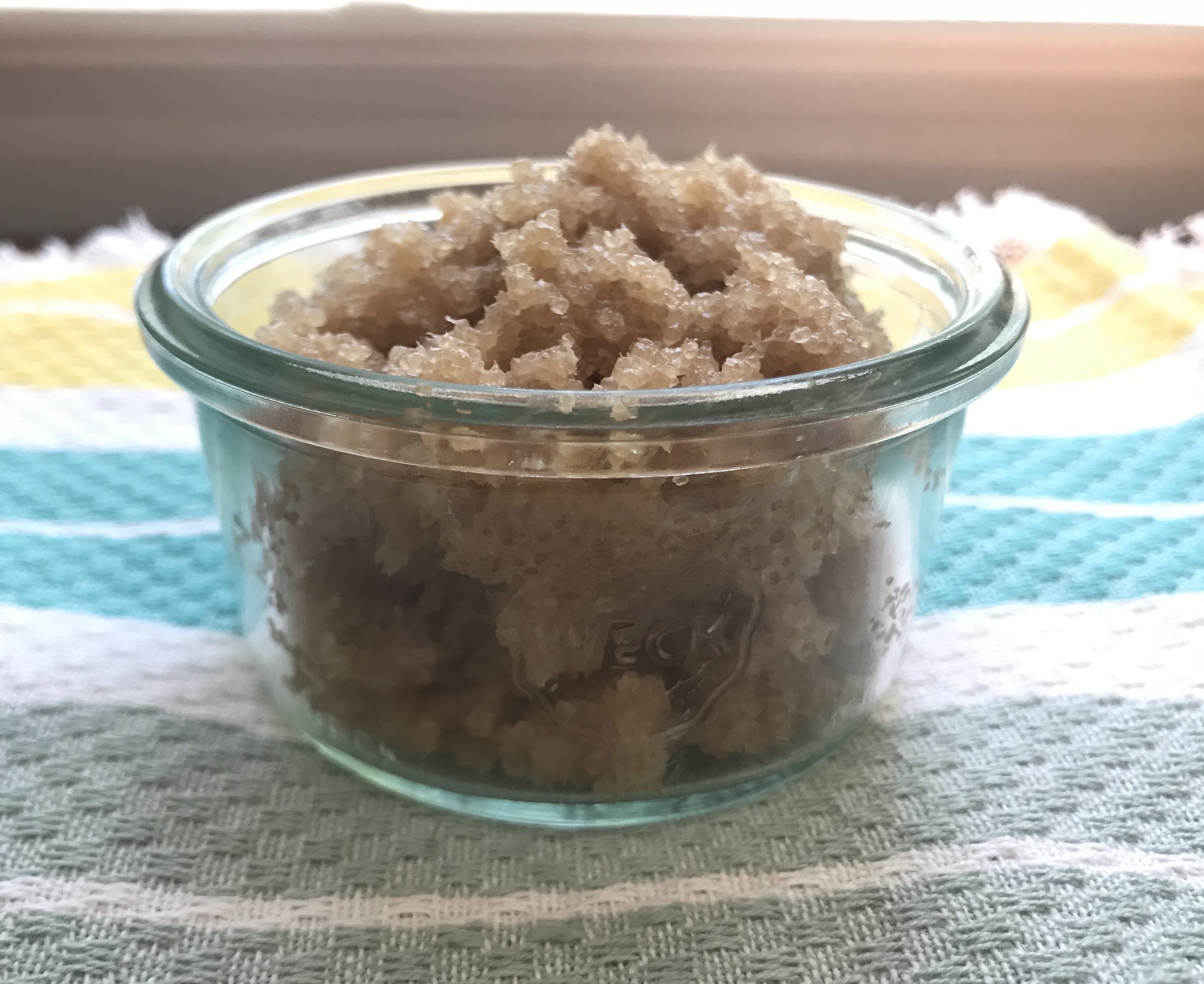
We all are trying to limit the amount of sugar in our diets, but here is a way to use the sweet stuff to actually support our wellness.
Sugar scrubs have been popular for a while, but I’ve been hesitant to use them, as my skin is extremely sensitive and easily irritated by chemicals and perfumes. Fortunately, though, sugar scrubs are easy and quick to prepare. Here are a few things to keep in mind.
Use organic raw or Turbinado sugar (its crystals are large and golden in color). Use organic coconut or olive oil, the best quality you can find. (If you can’t eat it, don’t put it on your skin).
Scent your scrubs with organic, high-quality essential oils, if you desire. They will add not only an aromatherapy component to your scrub, but they are also good for your skin. (Try oils such as lavender, Roman chamomile, Frankincense, or jasmine.
Stay away from using peppermint, especially on your face, as it could be irritating.)
Finally, use the scrub regularly, but not everyday, especially if your skin is sensitive. A couple of times a week is plenty.
You can use this scrub on your face and body, but again, be gentle. Don’t rub too hard, especially on your face.
I like to make this scrub and keep it in a pretty glass or plastic (safer) container in my shower so it’s always available.
I hope you try this recipe; let me know what you think.
1 cup organic Turbinado sugar
1/2 cup organic unrefined coconut oil
About 3 drops essential oil (optional)
Stir together all of the ingredients in a bowl or container. Store, covered, at room temperature up to one month.
 Sistering to Sophia